The Science Behind Regulator Performance in Cold Water
My regulator free-flowed at 28 meters in 6°C water off the coast of British Columbia. One second I was breathing normally, watching a wolf eel retreat into its den. The next second, air was screaming out of my second stage in an uncontrollable torrent.
The sound is distinctive. A roar. Your SPG needle starts moving visibly. You have maybe four minutes of air left, and you're almost 30 meters down.
I got to the surface safely. But that experience — combined with the fact that I'm a chemist who actually understands thermodynamics — sent me deep into the science of why this happens. Here's what I found.
The Physics of Why Regulators Freeze
Three concepts. All of them connect.
Boyle's Law and Pressure Reduction
Your tank holds air compressed to roughly 200-300 bar (3,000-4,500 PSI). Breathing that directly would destroy your lungs. Your regulator reduces this pressure to ambient — the pressure of the water around you — in two stages.
The first stage drops tank pressure to an intermediate pressure, typically 9-11 bar above ambient. The second stage drops intermediate pressure to exactly ambient. That's what you breathe.
The Joule-Thomson Effect
Here's where my chemistry brain gets excited. When a gas expands rapidly through a restriction — like a regulator valve — its temperature drops. This is the Joule-Thomson effect. Same principle that makes air feel cold when you let it out of a tire valve. Same principle that makes your refrigerator work.
In a first stage, the pressure drop from 200 bar to 10 bar is enormous. The gas temperature can plunge by 20-40°C as it passes through the valve seat. Even if the surrounding water is 10°C, the internal temperature of the first stage can drop well below freezing during each breath.
I'll say that again. The inside of your regulator can be below 0°C even when the water around it is above freezing. That's the Joule-Thomson effect doing what it does.

The Free-Flow Cascade
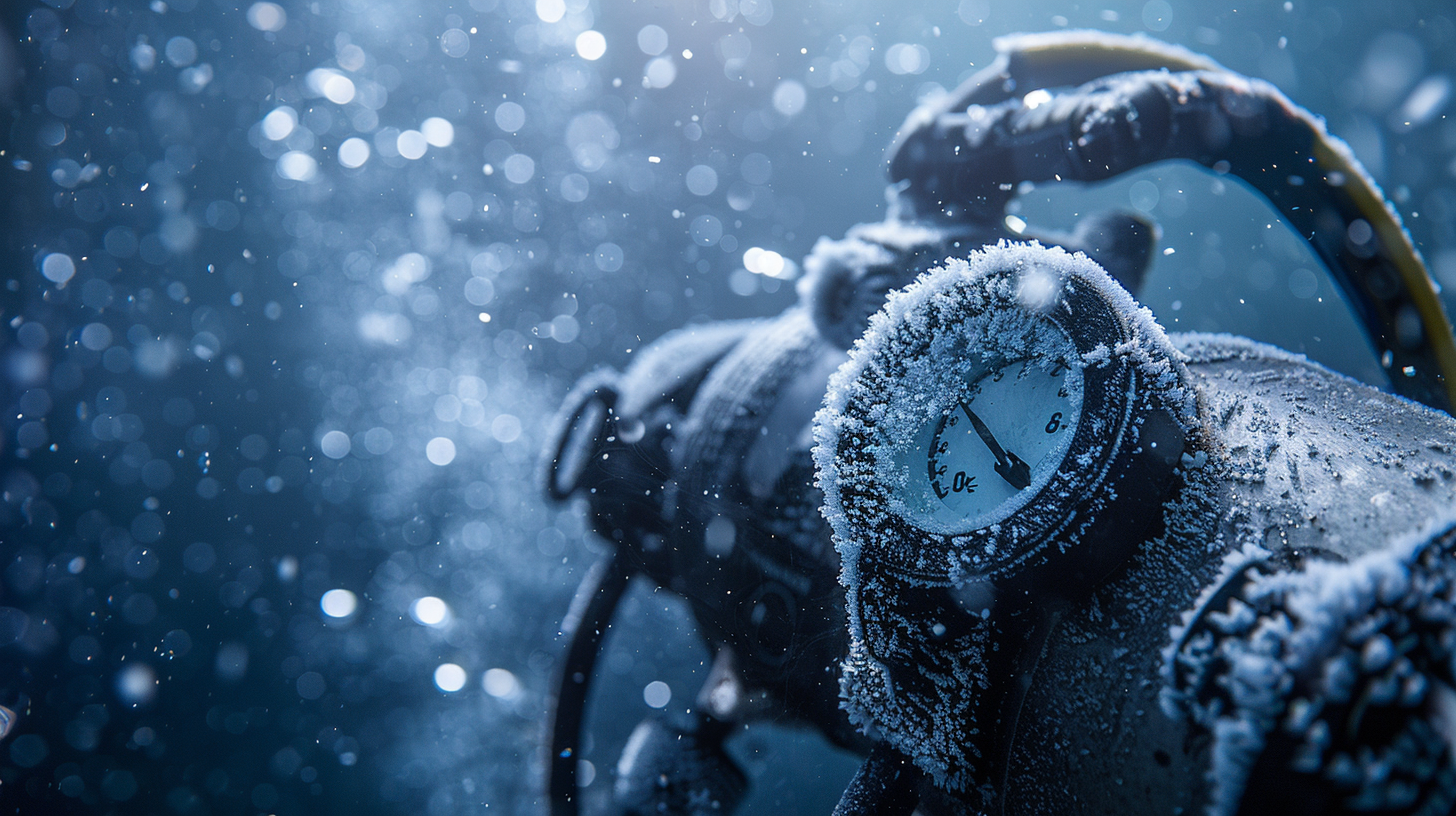
When internal components hit 0°C, moisture in the breathing gas — and any water that's entered the mechanism — starts to freeze. Ice crystals form on valve seats, springs, and diaphragms. Then the cascade begins:
1. Ice forms on the first stage valve seat. The valve can't fully close. 2. The valve stays partially open. Intermediate pressure rises above its set point. 3. Elevated IP pushes on the second stage diaphragm. The second stage thinks you're inhaling. It opens. 4. Air flows continuously. Free-flow. 5. Increased airflow through the first stage causes more Joule-Thomson cooling. More ice forms. 6. The cycle accelerates. Once it starts, it rarely stops on its own.
This cascade can drain a full tank in 3-5 minutes. That's not a slow leak. That's an emergency.
How Engineers Fight Freezing
I've read the engineering specs on every major cold-water regulator. Here's what actually works.
Environmental Sealing
The most effective anti-freeze approach. An environmentally sealed first stage fills the spring chamber with silicone fluid and seals it from outside water. Two benefits:
1. No water enters the mechanism. No water means nothing to freeze. 2. The fluid conducts heat from surrounding water to internal components, partially counteracting Joule-Thomson cooling.
The Apeks XTX200, Scubapro MK25 EVO, and Aqua Lung Legend LX are all environmentally sealed. This is the baseline requirement for cold water. Non-sealed regulators should never be used below 10°C. Full stop.
Diaphragm vs. Piston First Stages
This distinction matters significantly in cold water.
Piston first stages use a single moving piston. Fewer parts, easy to service, high airflow. But the piston protrudes through the body, creating a direct thermal bridge between cold water and internal mechanism. Even sealed, piston regulators are more susceptible to freezing because metal conducts cold inward. Basic heat transfer — Fourier's Law.
Diaphragm first stages use a flexible diaphragm to sense ambient pressure. The valve mechanism sits entirely within a sealed dry chamber. The diaphragm provides thermal isolation. Cold water contacts the diaphragm, but valve components are separated from it.
For cold water: environmentally sealed diaphragm first stage. That's the gold standard. The Apeks DST and Poseidon Xstream series exemplify this.

Heat Exchangers and Fin Designs
Some regulators use clever mechanical design to manage thermals:
- Heat exchanger fins on the first stage body increase surface area in contact with water, drawing warmth to counteract Joule-Thomson cooling. The Apeks XTX series has prominent fins for this.
- Extended second-stage heat sinks draw warmth from exhaled breath (~37°C) to warm the demand valve mechanism. Your exhalation is a heat source. Smart engineering uses it.
- Metal second-stage components instead of plastic improve thermal conductivity.
ANSTI Cold-Water Testing
The European standard for cold-water regulator testing. The regulator sits in 2-4°C water, subjected to demanding breathing patterns at 50 meters simulated depth for a sustained period.
Regulators that pass earn EN 250:2014 Class A certification. This isn't marketing. It's a reproducible test under controlled conditions. When buying a cold-water reg, look for Class A. Accept no substitutes.
Your Behavior Matters Too
Equipment only gets you so far. Your breathing affects freezing risk as much as your reg choice.
High breathing rates accelerate freezing. Every breath pulls more gas through the first stage, increasing Joule-Thomson cooling. A calm diver generates far less internal cooling than a stressed, heavy-breathing diver.
Continuous purging is dangerous. Holding the purge button in cold water is one of the fastest ways to induce a free-flow. The massive airflow creates extreme cooling.
Pre-dive breathing wastes gas and cools the reg. Some divers breathe from their reg while floating on the surface before descending. In cold water, this initiates cooling before you've even started.
My cold-water breathing protocol:
- Breathe slowly and deeply. Not quickly and shallowly.
- Never purge unnecessarily.
- Don't breathe from the reg on the surface if you can avoid it.
- If you feel increased airflow resistance or a crackling sensation, signal your buddy immediately. You may have seconds before full free-flow.
What To Do During a Free-Flow
This happened to me, so I'll tell you what actually works:
1. Don't remove the regulator from your mouth. You can still breathe from a free-flowing reg. Tilt your head so the second stage faces slightly downward. Excess air escapes around the mouthpiece while you continue breathing. 2. Signal your buddy. "Something's wrong" signal. Point to your reg. Then "ascend" signal. 3. Begin a controlled ascent. Prompt but not panicked. A free-flowing tank has limited time. 4. Switch to your alternate air source and shut down the affected first stage if you have an isolator manifold or pony bottle. 5. Monitor your SPG. It will drop fast. Know what it reads and calculate how much time you have.
My Top Cold-Water Regulators
Based on ANSTI testing, published data, and personal experience:
1. Apeks XTX200/DST — Dry-sealed diaphragm first stage with overbalanced second stage and heat exchanger. The benchmark. This is what I dive in cold water. 2. Scubapro MK19 EVO/G260 — Environmentally sealed diaphragm. Outstanding breathing performance and cold-water test results. 3. Poseidon Xstream Deep — Swedish engineering for Scandinavian conditions. Unique servo-valve first stage with exceptional flow characteristics. 4. Aqua Lung Leg3nd — Overbalanced diaphragm with auto-closure device. Strong ANSTI performance.
Investing in a cold-water rated regulator isn't luxury. It's ensuring your life-support equipment works when conditions are worst. When you're at 30 meters in 4°C water, you want the best engineering money can buy between you and your air supply.
Trust me. I've been on the wrong side of that equation.
More Gear Reviews
Browse all gear reviews on the [OkToDive blog](/blog). Every review is written by a chemist who tests gear, not a marketer who photographs it.
→ [Trip Planner](/trip-planner) — match your gear to the right destination | [Best places to dive](/blog/best-places-to-scuba-dive)
→ [Subscribe to The Depth Report](/#newsletter) — monthly gear reviews, dive site scores, no hype.
I'm Chad. Your chemist who respects the Joule-Thomson effect.